


How It Began
(Click on any of the graphics to view the
enlarged version)
The following are excerpts from a book “Norsk Nybyggerliv I Natal” compiled by Andrew and Anna Halland and Ingeborg Kjonstad in 1932. This was later translated into English by A.H.E. Andreason in 1932 to mark the 50th Jubilee of the landing of the Settlers on the 29th August 1882
Bjornson, Norway's great poet, expressed the Norse folks' "wander-lust" – urge to emigrate - from early history, when he wrote:
“Norrona folket det viI, fare,
Det vil fore-kraft til andre."
The Vikings and later, the explorers, Nansen
(North Pole) and Amundsen (South Pole) won fame and renown for
Norway.
Despite the wonderful nature, mountains and fjords of Norway, its
valleys were narrow and living was hard. Up to 1880 America had been
the goal for seeking pastures new." Now, voices from the South
brought a change of direction. In the trail of missionaries to
Zululand, Captain Landmark, Master of the Mission ship, “Elieser”,
went on an exploring trip through Natal and Zululand. He was
impressed with the green hills, fruitful soil and sunny land. He
found few white people about and it struck him what an ideal country
Natal would be for Norse Colonists.
'Back in Norway, he wrote articles to the press, extolling the
glories of Natal. He also published a brochure giving information
about the geography and climate of Natal, also giving a list of
fruits, grain and vegetables to be grown. These brochures were
quickly sold out, as they gave valuable information to prospective
farmers.
Interest was aroused especially among farmers round Aalesund. A
letter of enquiry was sent to Mr. Emil Berg at the Seamen's Mission
in London for further information, and how to get there. Mr. Berg
contacted Mr. (later Sir) Walter Peace, who was the agent for the
Government of Natal.
After negotiations for emigration to Natal, they were promised free
passage from London for fifty families, under certain conditions, to
land at the mouth of the Umzimkulu River. They would be given a lot
of 100 acres for each family with 2,000 acres of common grazing of
cattle. The land would cost R1.50 per acre payable in ten years.
Each applicant would need a minimum sum of RlOO (£50) on arrival
against want in the early years. Applicants must have a doctor'
certificate of good health and a minister's letter of good conduct.
They were required to be men of integrity, sober, hard working and
Christian people, willing to be of mutual help. Each family was
allowed to bring two single persons.
People reckoned that these conditions were favourable, especially in
view of the- present hard times in Norway. Letters from the Colony
such as those from Daniel Nilsen and Isak Raffteseth also influenced
the relations favourably. One warning letter came from Rev. Stavem
of the Norwegian Mission, who considered that a sum of R600 (£300)
would be needed for the first years. Able artisans might get work at
R1 (10/-) a day. But the hardy young people were determined to
overcome such difficulties.
A committee was selected comprising Mr. A. Andersen as chairman, Mr.
K. Martinsen, a business man, and Mr. E. Bjorseth, a cabinet maker.
Applications came in mostly from Sunnmore and Aalesund, three from
Trondelag, two from Bergen - about three hundred in all, but only
fifty families were provided for.
Early in 1882 the necessary documents were received for completion
and attestation by doctors and clergymen. A busy time followed in
making preparations and disposing of such assets as they possessed
to ensure that the necessary money was available. The money was
handed over to Rasmus Ronneberg in Aalesund and paid out to the
emigrants after their arrival in Natal by Mr. Andersen.
Mr. Berg visited Aalesund early that spring and accepted his call as
priest for the colonists in the new country.
When the time came to embark, it was found that only 34 families
were ready for the venture.
NAMES OF THE HEADS OF THE 34 FAMILIES
-
K. Martinsen, merchant
-
A. Andersen, bookseller
-
E. Bjorseth, cabinet maker
-
O. P. Valdal, tailor
-
O. A. Vinjevold, farmer
-
J. Lillebo, builder
-
E. Haajem, ship builder
-
A. Bjorkelund, farmer
-
N. Gidske, farmer
-
K. HageseIle, farmer
-
J. A. Ole, farmer.
-
E. Pahr, teacher
-
I. Igesund, farmer
-
G. A. Kvalsvig, farmer
-
M. Holte, blacksmith
-
G. Kjonstad, teacher
-
J. Kjonstad, farmer
-
J. Nero, agronomist
-
C. Rodseth, goldsmith
-
L. Haram, farmer
-
I. C. Lund, landscape gardener
-
F. Hufft, weaver
-
J. Pettersen, farmer
-
P. Trandal, baker
-
J. Kipperberg, seaman and fisherman
-
S. Borgesen, bookbinder
-
R. Brune, boatbuilder
-
F. Bodtker, carpenter
-
K. O. Standal, painter
-
N. Oie, wagonmaker
-
R. Sandanger, builder
-
T. Dahle, mechanic and shoemaker
-
H. Andreasen, farmer
-
Rev. E. Berg
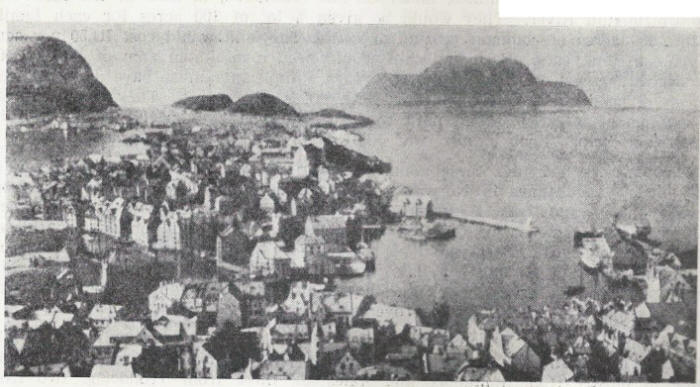
DEPARTURE FROM AALESUND - JULY 14, 1882
(Narrated by G. O. Kvalsvig, veteran of the immigration)
Being anxious to meet the emigrants, descendants of the Vikings, Mr. Walter Peace arrived in Aalesund on 9th July, 1882. A large festival had been arranged where friends and relatives met for goodbyes. Rev. Jerval spoke on the text from Romans 12:12 "Rejoicing in hope, patient in tribulation, continuing steadfast in prayer". Lay Preacher Olsen admonished the people with the text "Do not fall out on the way." Many heartwarming words were spoken, and a special hymn written as a parting wish by friends was sung. It contained the wish of God's presence, protection, and blessing. It was sung in a solemn tune.
On the 14th July, the Wilson boat, "Tasso," lay anchored at the quayside ready for departure. Small boats in great numbers lay round the ship - it seemed as if all Aalesund and district had come to see them off.
The weather was beautiful, the sea smiling, and the emigrants in high spirits. As the ship moved out, minds began to realise that they were leaving the beloved land of their birth, where they had been accepted by God in baptism and where they had learned the way of life from god-fearing parents and teachers. But a thought of comfort also occurred, that their God would be with them also in regions beyond.
Nearing Stadt, the point of turning south, seasickness attacked the passengers. One small boy in distress asked" Shall we be sick all the way, even in the train, Dad?"
Soon, however, England was in sight and they landed in Hull, on Monday, 17th July. After a good breakfast, they were soon packed in a special train for London, and there met by Rev. E. Berg, J. Pettersen and F. Bodtker from Bergen. Escorted by four policemen they safely reached the boat “Lapland" at the East India Docks, where Captain Potts and Dr. Stuart, the ship's doctor, received them. Each family was given a large cabin, with smaller ones for the single persons and a common dining saloon. The ship was clean and the food good. Next day, 19th July, in the Norwegian Seamen's Church in London, the ordination of Mr. E. Berg as the emigrants' church priest took place, Rev. Grondahl officiating. On the eve of departure, 20th July, Mr. Walter Peace made the following speech:
"Norwegian People, I must now bid you farewell. As the Government Official or Agent, my duties connected with your emigration are nearly done. You are aboard a good steamship, in charge of a good and experienced Captain. From him you will receive all attention and supervision you need. On my behalf as well as yours, I want to thank Mr. Donald Currie for his willing help, his exertions and his thoughtfulness in the special accommodations. As far as possible each family can travel together. The promises I made to you are fulfilled, in fact, some of the privileges you have received are better than we at first made you hope for. I am convinced that no previous emigration had better conditions than yours. The grass huts, your first dwellings are ready for you. All going well, you will reach your lots early in spring, so you can plough and sow in good time. From friends you corresponded with in Alfred County, you will see that descriptions have not been too glowing. I have no more to say as an Official in the Natal Government Service. You will receive all aid and guidance from the Land and Immigration Board after your arrival in Durban. They will assist in the difficulties to get to your first homes.
"Allow me a few words of a personal nature, as to the relation between us and to your future. It was a great responsibility laid upon me by the Government, a trust of honour to pick people of quality for the founding of a new Settlement in Natal. I did this to the best of my ability and with courage and I feel now as I look at you that my work has not been in vain. I have no doubt that your emigration to Natal will be a blessing to yourselves and that you will fulfil the Government's hopes by your energy and initiative. I shall not easily forget that afternoon in Aalesund, the small island backed by snowdecked hills, or the interesting festival with friends come to honour you and to wish God's blessing on your venture. It will be happy news to people in Natal that the new Colonists are Godfearing, and willing for mutual help in difficulties of early pioneer life. These difficulties will not be minimised by the use or misuse of strong drink.
"Your responsibility begins now - I pray you each not to forget it, not only to prove the trust laid on you for a diligent and exemplary moral life, in building the new homes, but also make faithful use of your possessions and show the best influence in your way of life. Honour your nation, blaze the trail for Christianity and civilisation for the heathen folk you get in contact with. I will say a hearty thank you to Messrs. Berg, Andersen, Martinsen for their help in our consultations. May God bring you safely to your desired haven, both in this world and in the next. Farewell."
Sir Donald Currie, the owner of "Lapland" spoke a few words and Rev. Berg on behalf of the emigrants conveyed their thanks. The "Lapland" slipped quietly from the quay, a little early on account of high water. Two of the boys got a fright as they came running too late to get aboard! They were put on the train for Tilbury, and taken aboard happily. At Dartmouth next day, the ship obtained provisions, water, live sheep and poultry.
Now the course turned south and England disappeared. The northwester set in, rain splashed on the ocean surface and darkness covered the Lapland. Only the white sea-foam round our ship was seen. The Lapland moved on with its precious cargo - 233 persons. All had been committed to God's care. Without His protecting guidance it could have been a dangerous passage. The rolling of the boat increased in the Bay of Biscay, and few were seen at the tables. Calming gradually at Madeira, it was fine weather. Here we passed a ship on its way to England bearing the rebel Zulu Chief Cetswayo, we were told. At Madeira, natives flocked up to our boat with fruit, wine and fancy-work for sale. Some youngsters dived for pennies, bringing them up between their teeth. Our ship took in further supplies and coal. At the Grand Canary the wind blew up sharply - the top sail was in danger of loosening up - the Captain requested someone to climb up to make it fast. Two of our boys climbed up and did it.
Rev. Berg arranged Christian meetings. services on Sundays and Sunday School. Marie Dahle played the guitar and Mr. Emblem played the violin. He organised a choir among the young. One of the songs was :
"Africa with gold." Time was spent in planning and tentative committees were set up for the future.
One day the steward opened the mustard bottle to show how to use it on salt beef for lunch. Two ladies took a spoonful each to their horror and to the amusement of the others. Nearing the equator it became warmer, the air was fine and all the passengers felt well. SomE! of the children had been very ill. Three had died and were buried at sea - Pahr's, Bjorkelund's and John Die's.
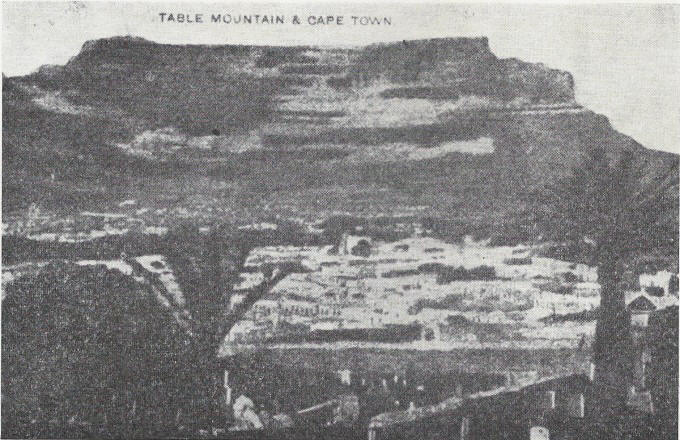
At the Equator the boys had fun. They fixed a hair across a man's glasses and asked if he could see the line. "Line, yes, quite clearly" he said. They also had fun watching flying fish, and caught some which dropped on deck. As the South Easter began blowing freshly our speed was modified but we moved on and early one morning we passed Robben Island, and soon lay anchored outside Cape Town. The Customs Officer came in a boat rowed by six men. After the customs inspection our boat was allowed to move to the quayside to take in coal and foodstuffs, but no one was allowed to land owing to smallpox in Cape Town. A policeman stood guard. The magnificent' view of Table Mountain impressed us.
On the way again Port Elizabeth was by-passed but we stopped at East London. Excitement grew as Natal was sighted but the straight coastline, so unlike the rugged coast of Norway disappointed us.
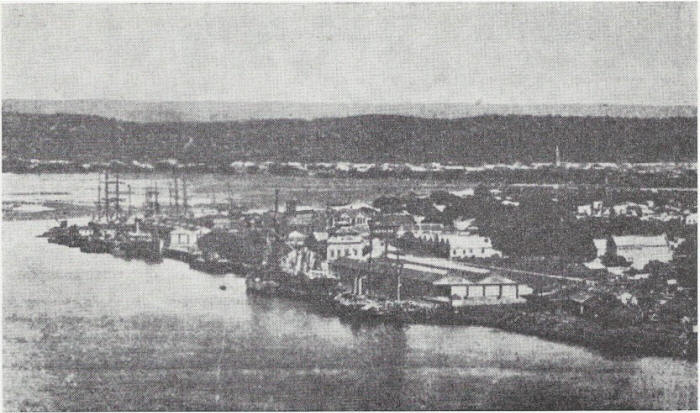
At dinner one night we were told that the Umzimkulu River was in view. Many rushed out, but it was too dark to see clearly; they did however see the bonfires which Mr. Bazley had made, as a welcome for the colonists. By midnight our boat arrived in Durban harbour stopping at the outer anchorage. Next morning, August 28, the men rose early for the first view of the much-talked of new country. They spied the Town Hall and houses on the Berea in the bright sunshine. At nine a.m. Mr. Butler, Secretary of the Immigration Board, together with a Customs Officer and several gentlemen came on board. They brought a map of the Settlement and the farms were allocated by the drawing of lots. Rev. Berg was given a lot in the centre and No. 17 was chosen for Church and school. Messrs. Rafteseth, Gorven and Hoidel came on board to bid us welcome and brought bananas, oranges and sweets for the children.
The 100 mile journey by land to the Settlement would have been hazardous, and expensive so the authorities offered to let the Lapland take them down. They arrived back at the Umzimkulu mouth late on the evening of August 28.
Mr. William Bazley fired five cannon shots as a welcome and the Captain sent up coloured rockets in reply, which pleased the people. Seeing the English colonists were on the shore to welcome them, our men gave three loud hurrahs. The choir on board sang some Sankey’s Hymns in Norwegian, guitar playing was heard and the ship's crew sang some of their songs. Early on August 29, a lighter came out to convey us to land. Rev. Berg now made a speech on behalf of the immigrants to the Donald Currie Co., thanking the captain and crew for their care and good attention on the voyage - the food had been plentiful and good. In reply the Captain said that he had transported emigrants before, but none had given him more pleasure than these Norse ones.
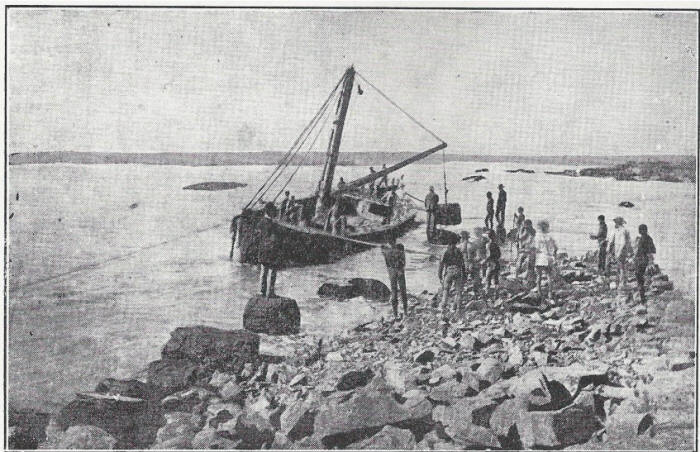
Now began the landing, the men used a ladder of rope, while the women and children were put in a basket with room for five, having a door at the side and lowered into the lighter - 128 persons were crammed into the lighter hold. As the waves splashed over the lighter the hatches had to be clamped down. A small steamer, the “Somtseu”, drew the lighter to the mouth of the Umzimkulu where a troop of Zulus pulled it over the sandbank and in through the river mouth. The poor tightly packed passengers suffered from heat and lack of air, became seasick and some fainted. They had forgotten to bring drinking water along. The towing of the boat across the sandbank took time but some of our seamen came to the rescue, opening the hatches, so the poor passengers could breathe freely again. They were relieved to step out on to firm land. The rest of the company came in the afternoon.
A number of the colonists were gathered to welcome the arrivals _ the English were David Aiken, Reid, Sinclair, Brickhill, Pearce, Woolly brothers, Bazley, General Bissett and W. Mason. The Germans were Mr. and Mrs. Sangmeister, Rev. Stoppel, Klusener, Ringo, and Kruger; Swedes Orenskjold and George Anderson; Norwegians B. Rafteseth, Rasmus Nilsen and H. T. Brudewold who was assigned by the Government to meet the arrivals and help them with guides and transport. Mr. Orenskjold was most helpful. Mr. D. Aiken invited Rev. Berg and family to his home for three days, while the luggage was unloaded. Mr. Brickhill gave accommodation to thirty immigrants in his new shop on the hill. Mr. Reid gave several lodging in his hotel. The Kjonstad family were taken to the brothers Rafteseth, the Huffts went with Ringos. The rest were lodged in Mr. Pearce's large shed. The' Captain sent blankets and ship's biscuits until supplies could be obtained. Mr. de Beauvais the Harbour Captain was helpful and Mrs. de Beauvais sent cakes and sweets for the children.
Mr. Duka Fynn, son of Henry Fynn, the Zulu chief of the district had staged a war dance by 400 Zulus as a welcome. Dressed in full war regalia with spears and cow hide shields they made a terrifying impression on the newcomers as they came down the hill with war cries, and began stamping back and forth until sand and dust were blowing in a cloud. The women and children fled to the big shed, some of the men entered the bush nearby, unable to fathom this strange welcome. Soon, however, three big oxen were driven into the dance and pierced with spears. The warriors drank the blood, the skins were torn off and the carcases cut up and grilled on coal fires round about. The immigrants were offered some underdone meat but they declined. However they enjoyed the tea, cakes and fruit brought by the colonists - they were served with mealie porridge from a large pot and found it quite tasty.
The next day, August 30, Rev. Berg conducted an impressive service on the river bank where they thanked the Almighty God and Father for their safe arrival in sunny South Africa, the goal of their happy dreams. They also invoked His blessing, help and guidance for the future.
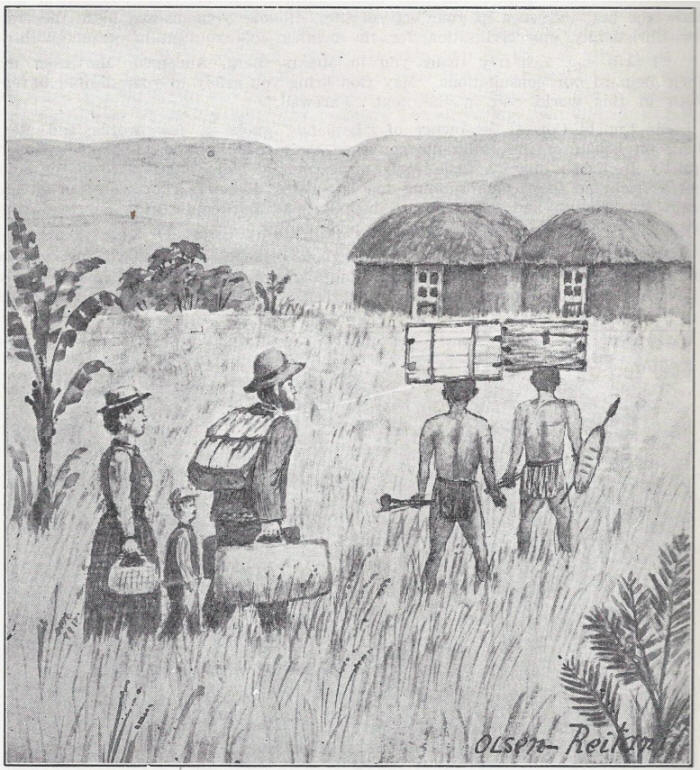
Mr. Klusener, a German who stayed with Rev. Stoppel at the Mission
Station, Marburg, was given the contract of carting the luggage of
the immigrants to their respective homes by ox-wagon. This took time
and many walked on in the tall grass; father carrying provisions,
mother carrying the baby with clothes parcels, big brothers and
sisters helping the smaller ones up the hills in the sun. Each lot
had two rondavels, the only window being the upper half of the door.
They had been built by the Government. The number of the lot was
nailed on the door. The huts did not look very inviting, the
thatched roofs were wind torn, and inside weeds and climbing plants
were growing on the crude earthen floors. Frogs, wasps nests and
snakeskins had to be swept out. Soon, however, the coffee kettles
were boiling in the middle of the floor and the families were
refreshed after the strenuous walk.
'When the ox-wagons arrived and the cups and dishes were unpacked, they found that much of their crockery had been broken on the way, an ox-wagon having overturned on the steep hill. The empty cases were soon converted into tables and chairs. A two hundred pound bag of maize meal was given to each family.
They had arrived at the place of their dreams, and felt the warm sun on the hillsides with the beginning of summer. Trees grew by the spruits and the rolling veld gave promise of fields of corn, but there was a secret feeling of dismay as they began to see the difficulties ahead. Still the joy of a successful voyage and safe arrival was great, and to build a home and make a success of their place in the Colony of Natal was the firm decision of one and all.
Certainly the Government had been helpful and generous. What the
future held either of prosperity or adversity no one could know.
NATAL MERCURY REPORT:
Arrival of the "Lapland" yesterday. Norwegian Emigrants "All Well"
"Departure of the steamer for the Umzimkulu, the C.H.M.S. 'Lapland,'
which was expected here a day or two since, arrived at this port
early yesterday morning. She had on board 36 families numbering 229
persons, who possess between them the capital to the extent of
about £2,400. They are Norwegian emigrants, and appear to be a fine
and hardy class of people, who will make first rate colonists.
Arrangements had been made to give up the whole of the passenger
accommodation on board the 'Lapland' to them, and to carry them out
direct.
"This concession has been highly appreciated by all concerned, and
those gentlemen who inspected them yesterday morning, prior to their
departure for the Umzimkulu, found them to be in tip-top condition,
and all content and happy.
"Those who visited them were Mr. B. VV. Greenacre (member of the
E.L.I.B.), Mr. C. H. Butler (Secretary), Mr. D. C. Andrew (Agent),
Mr. T. Petersen (who acted as interpreter) and a few Norwegians in
the town who had some friends on board. We hope in the course of a
day or two to be able to place before our readers some interesting
particulars connected with these useful emigrants."
"The first romance" in the settlement, began when young Mr. W.
Bazley chose his bride-to-be on the bank of the river. She was Miss
Margaret Martinsen. Their courtship was carried on with the help of
a Norwegian-English dictionary, and their rendezvous was
Sangmeister's Store.
Rev. Emil Berg was delighted to perform the marriage ceremony, and
General Bissett read an address at the wedding. It was truly a
festive gala day.
The bridal couple were towed in Bazley's boat by a whaler up the
river, and from the banks, Bazley's inevitable dynamite explosions
resounded. The young couple lived in two rondavels for many years.
They had two sons, Willie and Harry Knut.
On his retirement, Bazley built a magnificent home on the south bank
of ihe river, overlooking the river and sea. There he carried on his
hobby of collecting fossils and books, until his death.
Following this early example, scores of romances could be chronicled
in the history of the colony.
THE FAMILIES WHO ARRIVED ON THE “LAPLAND”
LOT 1: Rasmus Sandanger, wife Helene. With Peter Knotten, wife
Maren, child
Anders.
LOT 2: Matias Holte, wife Karen, child Konrad. With Johan Myklebust
and
Ane Muren.
LOT 3: Isak Igesund, wife Dortea, child Anna. With Jakob and Olava
Ribbestad.
LOT 4: Johan Nero, wife Karen, children Anna and Dorthea. With
Martin
Amundsen and Ane Sande.
LOT 6: Ole Valdal, wife Beate, children Marie, Lina, Olaf. With
Regine Johnson
and Severin Loken.
LOT 7: Kristian Rodseth, wife Kristine, children Aage, Anna, Marje,
Elisabet.
With Johanne Oie and Peder Ertesvaag.
LOT 8: John Kipperberg, wife Gurine. With Emblem, wife Marit,
children Trine,
Lauritz.
LOT 9. Elling Pahr, wife Ane, children, Olava, Kristine, Pernille,
Peder, Anna,
Eilert and Ole. With A. Hansen.
LOT 10: John Lillebo, wife Kanutte, children Peder, Anna, Pernille,
Andreas.
With Knut Myklebust and Jorgine Ensti.
LOT 11: K. O. Standal, wife Johanne. K. E. Standal, wife Oline.
LOT 12: K. Martinsen, wife Elisabet, children Margrete, Klara,
Elise, Martin.
With Kaia and Gudve Rogne and E. Brudevik.
LOT 13: Ole Haajem, wife Hendrikke, children Edvard, Anna, Laura,
Karl, Ole,
Nora. With Petrine, Hans and Nille Haajem.
LOT 14: Emil Berg, wife Kornelia, children Johan, Gusta, Marie,
Magda, Alfa,
Harald, Arthur. With Anna Brungot, J. Melseter.
LOT 15: C. D. Lund, wife Marie, children Sverre, Einar, Ragnhild,
Astrid. With
brother Tank Lund.
LOT 16: A. Andersen, wife Gertrud, children Johanne, Hilma, Andreas,
Karen.
With Elias Rodseth, Ingebrigt, Edvard Bye, Marie Jorgensen and
Vaernes.
LOT 17: Church and School Lot.
LOT 18: Peter Brune, son Ole. With Marie Moe and R. Nederhus.
LOT 19: O. Vinjevold, wife Oline, children Oline, Peder, Oluffa,
Anna, Josefine,
Andreas. With Anders Stigen.
LOT 20: F. Hufft, wife Kristine, children Sofie, Inga. With Jorgen
VoId and
Gurine Frisvold.
LOT 23: Martinus Gidske, wife Anna, children Anna, Petter, Bernt,
Berte. With
Johan Petersen and Nikoline Londahl.
LOT 25: Gjert Kvalsvig, wife Marie, child Gustav. With J. Johannesen
and Sevrine Paulsen.
LOT 29: Nils Oie, wife Malene, children John and Guttorm, Kannutte
and Ingeborg and Kornelia. With O.J. Brauteseth and Karoline Haajem.
LOT 30: T. O. Dahle, wife, children Anna, Gusta, Thea, Ludvig,
Oluff, Kornelius.
With Ingeborg Dyb, W. Andersen and Marie Dahle.
LOT 31: A. Birkelund, wife Marta, children Lars and Larsina. With
Ane Vatne
and Peder Dahle.
LOT 32: P. Haram, wife Cecilia, six children.
LOT 33: John Oie, wife Karen. With Olai Vatne and Malene Eidseth.
LOT 35: Borgensen, wife Marie, child Eivind. With Londahl, Wife
Ragnhild, children Martha, DevoId and Dorthea.
LOT 36: Pettersen and J. Andersen.
LOT 37: Knut Haggeselle, wife Johanne, children Sofie and Ida. With
mother
Maren and brother Anders, and Anna Karlsen.
LOT 41: F. Bodtker, wife Cecelie, children Fritz, Paul, Marie,
Rebekka. With L. Berntsen.
LOT 43: P. Trandal, Haakon Hjelle and Elen Ekornes.
LOT 44: J. Kjonstad, child Dina. With Ingeborg Valum and Olaus
Skjerve.
LOT 45: G. Kjonstad, wife Elise. With Dagna and Emil Holte. Zefanias
Olsen.
Grimstad, Karl Meeg and Lina Pettersen.
LOT 46: H. Andreasen and Kristian Olsen.
LOT 50: E. Bjorseth, wife Anne, children Anna, Peder, Alfred,
Olivia. With Johan Vernes.
A total of 229 passengers landed at Umzimkulu on 29th August, 1882.